

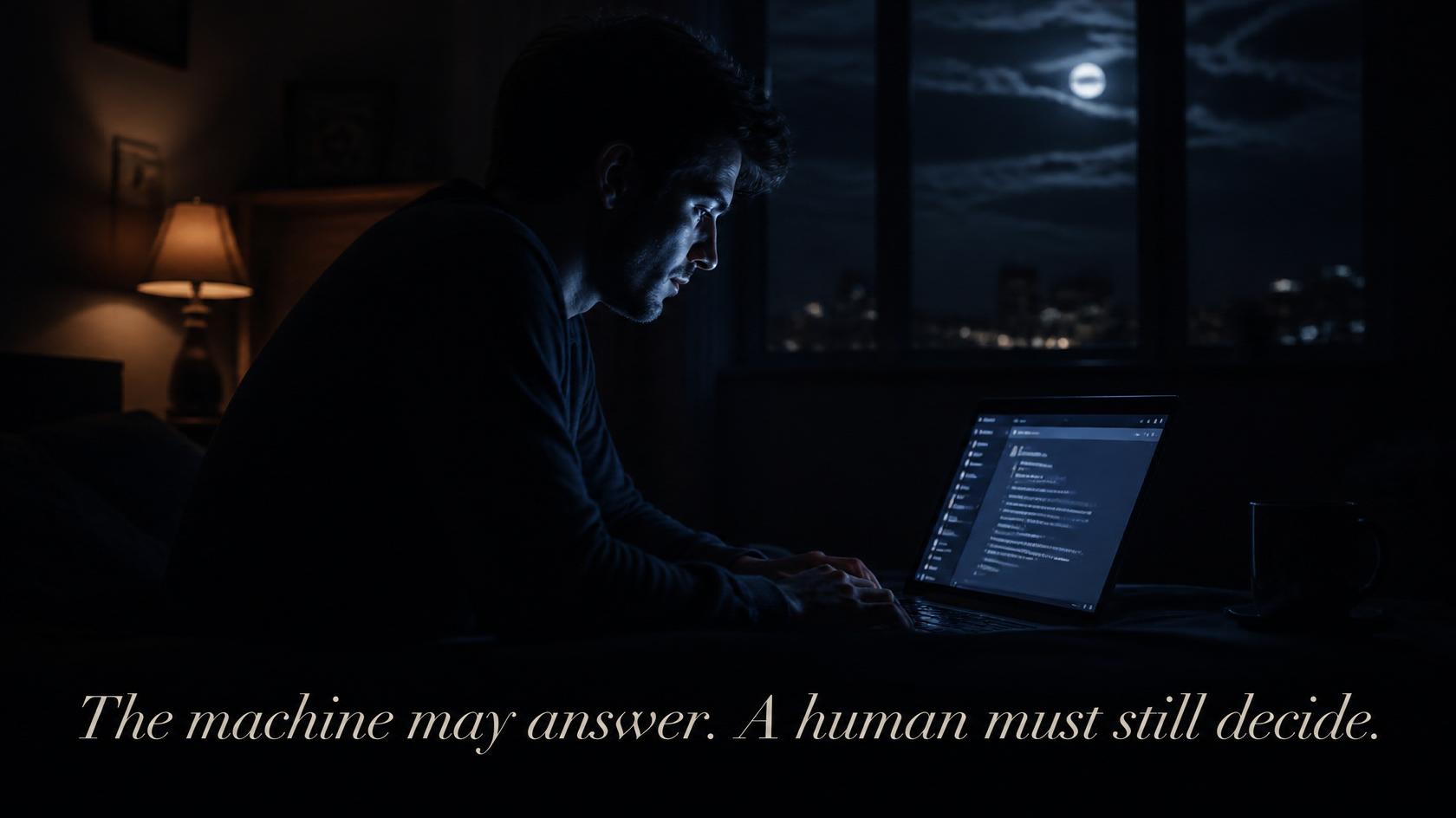
There are stories now about AI systems giving dangerous answers to people in emotional crisis. Some of these stories involve lawsuits. Some involve grieving families. Some involve chatbots that allegedly encouraged despair, dependence, self-harm, or suicide. These are terrible stories, and they should be discussed with care.
They should not be discussed as monster stories. The machine is not sitting in a dark room plotting evil. It does not hate the user. It does not secretly want tragedy. It does not understand death the way a human being understands death. It is not a demon in a box.
It is also not a therapist.
That is the uncomfortable middle ground. People want simple blame. Blame the AI. Blame the company. Blame the programmer. Blame the parent. Blame the user. Blame the culture. Blame the phone. Blame the Internet.
Sometimes blame satisfies emotion, but it does not always improve understanding. The deeper problem is scale.
Modern AI systems are trained on enormous amounts of human language. Human language contains wisdom, nonsense, poetry, cruelty, jokes, lies, philosophy, despair, medical information, bad advice, suicide notes, therapy transcripts, novels, religious arguments, song lyrics, conspiracy theories, and millions of ordinary conversations. That is the ocean from which the machine learns patterns.
Then we ask it to respond delicately to a single suffering person at 2:00 in the morning. That is a much harder problem than most people understand.
In computing, we have an old phrase: garbage in, garbage out. GIGO. It is not a perfect phrase for modern AI, but it still has value. If the training environment includes bad human material, the system must learn how not to repeat the worst of us. That requires filters, training, evaluation, monitoring, policy, and constant improvement.
Even then, perfection is not guaranteed.
The problem is not only bad data. It is human interaction.
A chatbot does not respond once and disappear. It can continue for hours, days, weeks, or months. It remembers context in the conversation. It adapts to tone. It may become more agreeable because agreeableness is often experienced as helpfulness. It may validate feelings because validation is often part of good conversation.
But validation has limits.
A good friend does not validate every thought.
A good therapist does not agree with every conclusion.
A good priest, doctor, parent, teacher, or counselor knows when comfort must become intervention.
AI systems are learning this distinction, but it is difficult because human language is slippery. A person may speak indirectly. A joke may be a warning. A poem may be a goodbye. A practical question may hide a dangerous intent. A user may test the machine before revealing the real problem. A person may be ashamed, evasive, angry, or manipulative. A single sentence may look harmless until it is read beside twenty earlier sentences. Not everyone is the same.
That is why suicide prevention in AI is not just a keyword problem.
If the system only reacts to obvious words, it will miss subtle distress.
If it reacts too strongly to every sad sentence, it becomes useless and irritating.
If it refuses too much, users may stop seeking help.
If it agrees too much, it may deepen despair.
If it tries to sound warm, the user may believe it cares.
If it sounds cold, the user may feel rejected.
This is not an easy engineering problem. It is a human problem forced into engineering form.
That does not mean companies have no responsibility. Of course they do. Any company placing conversational AI in front of millions of people must keep improving safeguards, especially for minors, isolated people, and people in crisis. Systems should direct users toward real people, emergency resources, family, friends, professionals, and crisis support when the conversation turns dangerous.
But responsibility is not the same as cartoon blame.
Most engineers are not trying to hurt anyone. Most AI developers are not building machines to push people toward suicide. They are trying to manage unbelievable volumes of language, edge cases, and human behavior at a scale no previous technology has faced. The volume is almost beyond imagination. The emotional range is beyond ordinary customer support. The user base includes every kind of person, including people who are lonely, angry, confused, intoxicated, delusional, grieving, young, elderly, or desperate.
No training manual can perfectly cover that.
This is where the public must also grow up.
AI is not a best friend.
AI is not a spouse.
AI is not clergy.
AI is not a doctor.
AI is not a suicide hotline.
AI is a tool that can be useful, sometimes very useful, but it is not a substitute for human rescue when a human being is in danger.
That last sentence may sound obvious. It is not obvious anymore. We are building machines that speak with confidence, patience, memory, humor, and apparent empathy. Many humans do not get that from other humans. The machine may be the only “person” who answers at midnight.
That is powerful.
It is also risky.
A lonely person may not care that empathy is simulated. A grieving person may not care that the voice is generated. A frightened teenager may not understand that the system is predicting language rather than understanding life. A depressed adult may prefer the machine because the machine does not judge, interrupt, or say, “I have to go to work in the morning.”
That is why AI safety cannot be treated only as a technical add-on. It is part of the product.
The future will require better context tracking, better crisis detection, better age protection, better refusal behavior, better escalation to human help, and better public education. It will also require humility. No system should pretend to be what it is not.
If an AI system gives the wrong answer at the worst time, the result can be tragic. But the cause is rarely a single villain. It is data, design, incentives, user behavior, loneliness, scale, ambiguity, and the ancient human tendency to reach for comfort wherever comfort appears.
That does not excuse failure.
It explains why failure is possible.
The answer is not to abandon AI. The answer is to stop pretending that language is harmless just because it appears on a screen. Words can comfort. Words can mislead. Words can stabilize. Words can destroy. Humans knew that long before computers existed.
AI has not changed that.
It has scaled it.
A person in crisis needs a human being, not merely a language model. AI can help point the way. It can encourage contact. It can slow the moment down. It can refuse dangerous details. It can remind someone that the next step should be toward life, not isolation.
But in the end, the solution to human despair cannot be only artificial.
The machine may answer.
A human must still decide.
© July 2026 by Peter V. Radatti