

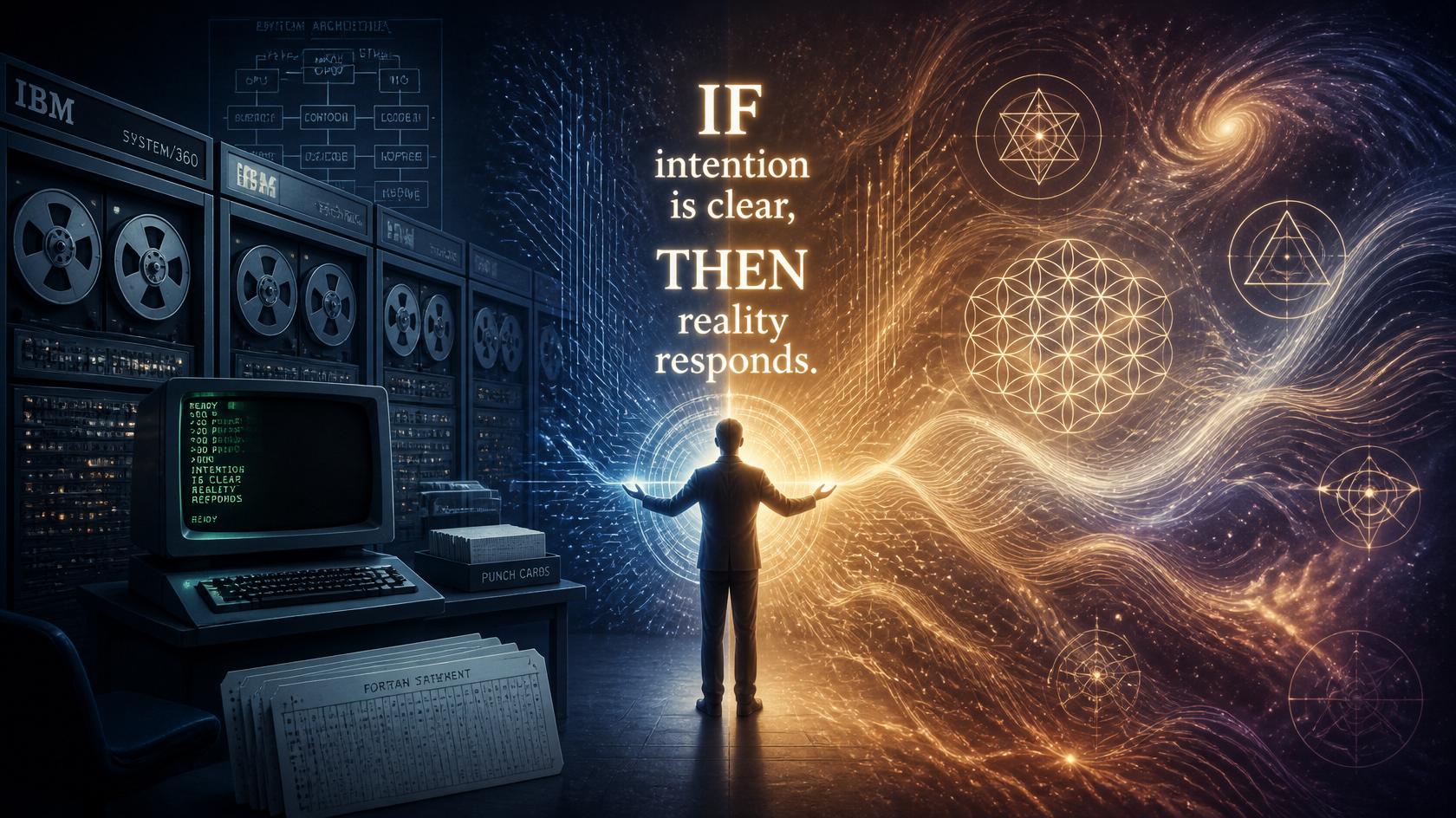
When I first began working with computers, they were not fashionable. They were not friendly. They did not smile at you from a phone. They were machines that required logic, discipline, and a willingness to think in steps. They also took up entire floors of large buildings.
A computer does not care what you meant. It cares what you instructed.
That is one of the reasons I find the comparison between radionics and programming so useful. Radionics may operate in a different layer of reality, but the discipline of instruction still matters. A vague instruction produces a vague result. A confused instruction produces confusion. A contradictory instruction may produce nothing useful at all.
In computer programming, we use structures such as IF, THEN, ELSE, and LOOP.
IF this condition is true, THEN do this.
ELSE do something different.
LOOP until the task is complete.
Those words are simple, but civilization now runs on them. Banking systems, aircraft, medical equipment, telephones, websites, security systems, and manufacturing plants all depend on logical structures. The modern world is full of invisible instructions. Even before computers, the IF, THEN, ELSE logic was in constant and hidden use. Example: IF hungry THEN eat ELSE do not eat.
My working view is that radionics can also be understood through informational instructions. This does not mean radionics is the same as computer programming. It is not. A computer is a physical machine executing electronic states. Radionics appears to operate through a relationship among operator, witness, intention, rate, symbol, and reality itself. That is a larger and stranger system. A computer can only follow directions, even when they are wrong. Radionics is tied to reality itself, which appears to have intelligence. This is why I often say, “Do it wrong and it works anyway!” It is because if reality likes what you want to accomplish, it helps.
But the analogy is useful.
A rate can be seen as a stored pattern. A witness can be seen as an address. An intention can be seen as an instruction. A radionics machine can be seen as a structured interface. The operator is not outside the system. The operator is part of the circuit and part of the authority behind the instruction.
This is where radionics becomes especially interesting, because I have spent much of my life around computers, signals, software, and security. In ordinary computer security, a properly formed instruction can change the behavior of a system. In radionics, we appear to be investigating whether properly formed informational patterns can influence the behavior of living systems, places, circumstances, or other targets.
That is a large statement. It should not be considered carelessly.
It also should not be dismissed merely because it is uncomfortable.
One of the developments I find important is the idea of stored-rate cards functioning somewhat like programs. If a useful rate pattern can be stored, copied, organized, and reused, then radionics begins to develop libraries. A library changes everything. It allows experience to be preserved. It allows beginners to benefit from the work of advanced operators. It allows complex work to be assembled from smaller components.
That is exactly what happened in software. Early programmers wrote everything by hand. Later, libraries developed. A beginner today can build something powerful because he does not have to reinvent every piece from nothing. He can call upon existing functions, structures, and tools.
Stored-rate libraries may serve a similar role in radionics.
This does not remove the need for skill. A fool with a powerful library is still a fool. In fact, he may become a more dangerous fool because he can act more quickly. Tools do not replace judgment. They amplify it.
That is why I believe radionics education must include more than “how to turn the knobs.” It must teach how to think. It must teach targeting, witnesses, intention, ethics, observation, and review. It should also teach the operator not to be impressed by his own imagination. Imagination is useful, but it is not proof.
The idea of UTran, my name for a radionics programming language, is partly humorous. The name is modeled after Fortran, an old and very real computer language. But the idea behind it is serious. If reality has an informational side, then logic may have a place in radionics. Conditional operations may matter. Repetition may matter. Default constraints may matter. Need may function as a condition.
This opens many questions.
Can a radionic program continue until it is no longer needed? Can it pause when conditions are wrong? Can a library of stored rates select only what is appropriate to the situation? Can an operation be structured so that it does not exceed ethical or practical limits?
I believe these questions are worth asking.
Some people want radionics to remain wrapped in mystery. I understand that. Mystery is attractive. It makes the field feel special. But mystery without structure becomes confusion. If radionics is to mature, it must become more disciplined, not less.
That does not mean stripping away wonder. It means giving wonder a framework.
A programmer learns quickly that reality inside a machine is unforgiving. A misplaced symbol can stop everything. A careless instruction can produce unintended results. Radionics may not behave exactly like a computer, but I suspect the lesson still applies.
Say what you mean.
Know what you are addressing.
Structure the operation.
Observe the result.
Review honestly.
That is not as glamorous as pretending to command the universe. It is much better. It is how a field grows from stories into practice.
The other thing that you can keep in mind to ease your way into Radionics is that the Universe is alive and thinking. It wants to help us. It knows the difference between what you say and what you want. Often, but not always, you can “do it wrong and it works anyway.”
© July 2026 by Peter V. Radatti