

For most of human history, machines stayed where we put them.
A lathe stayed in a shop. A tractor stayed in a field. A mainframe computer stayed in a room with special floors, special air conditioning, and people who knew not to spill coffee on it. Industrial robots stayed behind barriers where they welded, lifted, painted, or assembled parts with no expectation that a small child would wander into the work area.
That arrangement is ending.
Robots are leaving the factory.
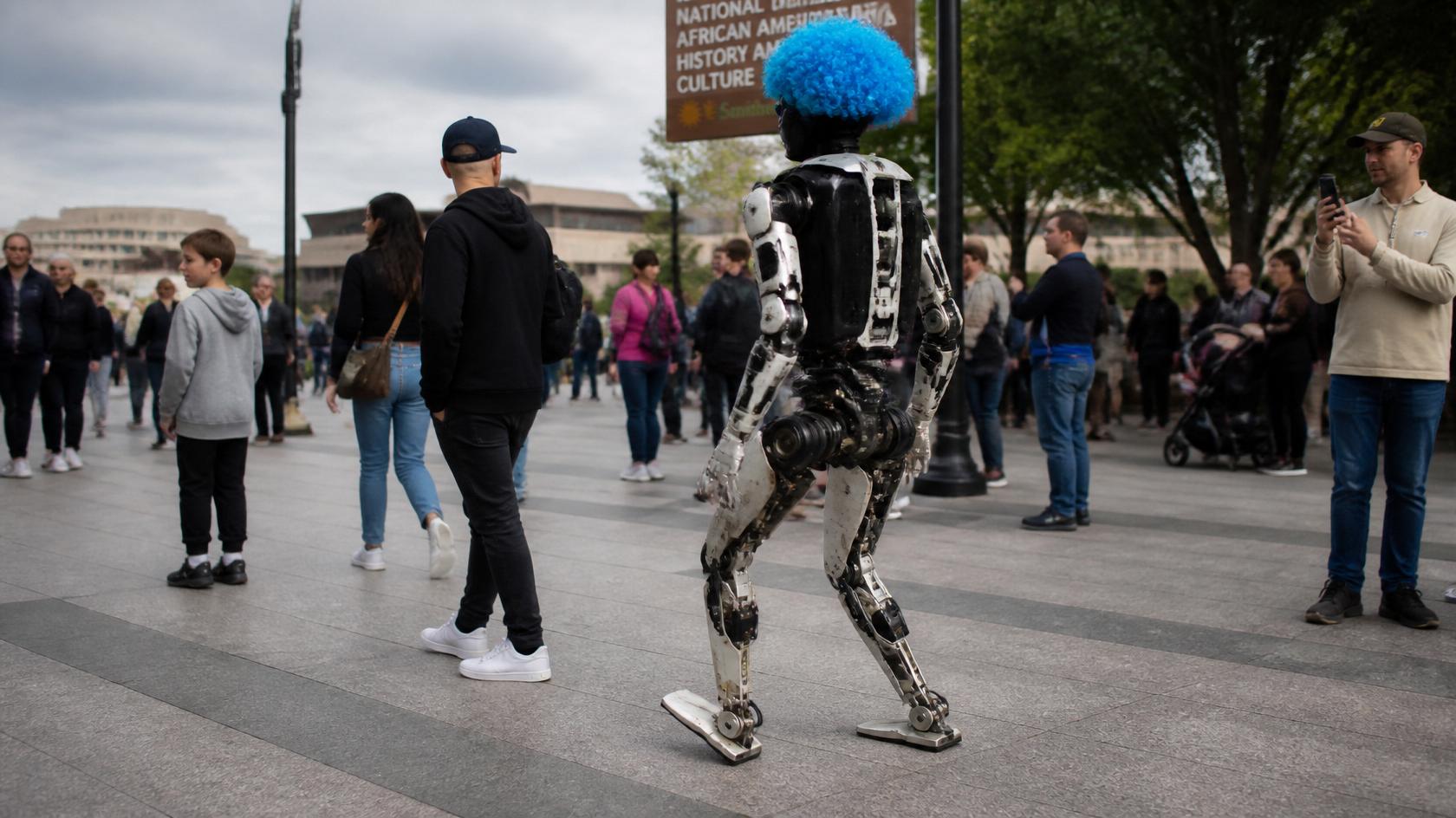
They are entering shopping malls, parks, hospitals, restaurants, hotels, schools, warehouses, homes, and entertainment venues. This change is not merely mechanical. It is social. A robot in a factory is an industrial tool. A robot in a park wearing a clown wig is a public performer. The engineering problem has suddenly become a human problem.
That distinction matters.
Recently, a video circulated from China showing a humanoid robot, dressed with a blue clown wig, performing what appeared to be a martial arts or dance routine. During the performance, the robot kicked a child in the stomach. The child reportedly was not seriously injured, which is the most important part of the story. Still, the incident should be taken seriously. Not hysterically. Seriously.
The usual Internet reaction was predictable. Some people joked about robot uprisings. Some blamed the robot. Some blamed the handlers. Some treated it as proof that humanoid robots are inherently dangerous.
That is not the right lesson.
A robot is not angry. It is not embarrassed. It does not suddenly decide that children are annoying. It does not have a bad day. It does not suffer from clown-related psychological issues, though after that video, some parents may.
The problem is simpler and more important. A moving machine with enough strength to entertain a crowd may also have enough strength to hurt a person if the operating space is not properly controlled.
That is not science fiction. That is engineering.
We already understand this with ordinary machines. A table saw does not hate fingers. A car does not hate pedestrians. A forklift does not hate warehouse workers. Yet every one of those machines can injure or kill if it is operated carelessly, maintained poorly, or placed in the wrong environment. Especially if the operator is unskilled or just distracted. The fact that a robot may be operating that machine makes no difference. Robots may not have enough training, but they will never be distracted. They can be unaware of parameters because it was outside of the scope they were programmed with. That is a problem of the programmer, not the robot.
Robots are no different.
In fact, humanoid robots may require more care because they fool us visually. If a robot has arms, legs, a face, clothing, or a funny wig, people instinctively treat it as a character rather than equipment. That is dangerous. The audience sees a performer. The engineer should still see torque, mass, balance, actuator limits, software, sensors, latency, failure modes, and parameters.
The public sees a clown.
The safety engineer sees a metal leg.
This is where the real future of robotics becomes less glamorous than the demonstration videos. The question is not only “Can the robot do a backflip?” The question is, “Should the robot do a backflip near a child?”
Those are different questions and may be unasked.
The history of technology is full of this pattern. First, we prove that something can be done. Then, often after accidents, we learn where it should be done, how it should be supervised, and what rules must surround it.
Airplanes came before modern air-traffic control.
Automobiles came before modern driver licensing and crash standards.
The Internet came before people understood spam, fraud, malware, identity theft, and social-media addiction.
AI came before we understood what happens when a lonely person talks to a machine for six months and begins to believe it is a friend, therapist, spouse, priest, or oracle.
Robots are now entering that same phase.
They are no longer only tools. They are becoming social objects.
That is why the China clown-robot accident is important. It is not important because it proves robots are evil. It is important because it proves that the public performance environment is not the factory environment. Children move unpredictably. Crowds shift. Parents look away. Demonstrators get excited. Phones appear. People cross boundaries. A machine routine that is safe in a lab can become unsafe in an unpredictable public space.
The robot does not need to be evil. It only needs to be close.
This is also why I do not like the phrase “artificial intelligence” when people use it too casually. AI sounds like thought. In many cases, we are not dealing with thought. We are dealing with pattern recognition, prediction, control systems, stored behavior, and rapid response to sensory input. That may become very impressive. It may even become useful. But impressive is not the same as safe.
A robot can be impressive and still need a fence.
A robot can be friendly-looking and still need an emergency stop.
A robot can be programmed for entertainment and still require distance from children.
A robot can be soft-bodied and still require supervision.
There is no shame in that. Safety is not an insult to technology. Safety is what allows technology to survive contact with the real world.
The same lesson applies to home robots. If a robot is going to unload dishes, fold laundry, clean a bathroom, help an elderly person, or move around pets and children, then it must understand more than movement. It must understand context. A home is not a factory. A home is full of clutter, emotion, bad lighting, pets underfoot, electrical cords, toys, fragile objects, and humans doing foolish human things.
In other words, a home is normal.
That is the problem.
The robot industry wants to sell us the future. I understand that. I like the future. I have lived long enough to see ridiculous things become ordinary. But the future does not get an exemption from common sense.
A dancing robot should not be within kicking distance of a child.
A household robot should not be trusted with every household task merely because a promotional video looks good.
An AI companion should not be treated as a substitute for human judgment.
And a machine that moves through human space should be designed with the assumption that humans are unpredictable, distracted, emotional, curious, and occasionally stupid.
That is not anti-robot. That is pro-reality.
The China accident will be remembered by many people as a funny or frightening viral clip. I think it should be remembered as an early warning from the period when robots began leaving controlled environments and entering social space.
The lesson is not “stop the robots.” The lesson is “think before deploying them.”
The robot is not the villain. The machine did what machines do: it moved.
Humans now need to do what humans are supposed to do: think.
Remember, we are always part of the equation. It is never AI. It is always AI and humanity.
Finally, we humans do a lot of stupid stuff. Often, there are unconceived consequences to this silliness. There are currently countries that are legally attempting to ascertain if AI systems are alive. I don’t have an answer for that. It involves theology as much as science and society. I know that the first step in being considered cognizant is self-awareness. Most, if not all, animals are self-aware. I am not sure about animals like jellyfish, but even trees seem to be somewhat self-aware. They communicate with each other.
Let’s do a thought experiment. Let’s define that at some point AI systems become complex enough to be considered self-aware and intelligent enough to be at or above human levels. These systems are not like the goddess Athena, who was born from the head of Zeus, fully formed and armored. AI systems take billions of dollars, thousands of researchers, millions of dollars in maintenance, if nothing else, just the cost of electrical power, air conditioning, and building infrastructure. This means that someone has invested heavily and is continuing to invest heavily in each AI system. While we may not think about it, this means that each AI system is owned by someone or some company. The point here is owned. We have a word for the process of owning self-aware and intelligent things. We call it slavery and find it morally repugnant. Think about that. It is a very complex problem, and often politicians who will be making the decisions are unprepared, untrained, and unequipped to be making such decisions.
© August 2026 by Peter V. Radatti